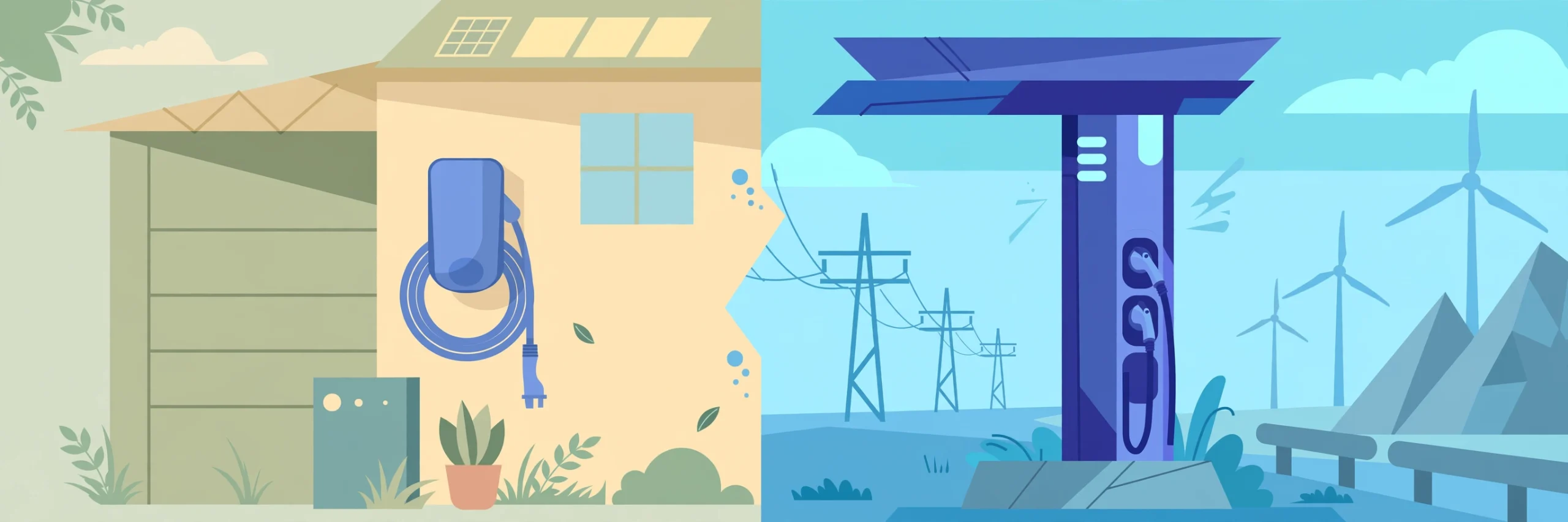
DC Fast Charging vs Home Charging: Cost, Speed & Battery Health
Quick answer: Home charging costs roughly $0.17/kWh in the U.S. versus about $0.47–$0.49/kWh for public DC fast charging — roughly three times more. Home charging is slower (hours) but cheapest and gentlest on the battery; DC fast charging adds big range in 20–40 minutes but carries a premium price. Most owners use home charging daily and fast charging for road trips.
Key takeaways
- Home charging is almost always the cheapest option — public DC fast charging typically costs 2–4x more per kWh, varying by network.
- DC fast charging adds 100+ miles in 15–30 minutes but slows dramatically past 80% as the charge curve tapers to protect the battery.
- The 80/20 rule works for most owners: ~80% of charging at home overnight, ~20% fast charging on road trips.
- Occasional fast charging is fine for modern EVs; it’s near-exclusive fast charging, especially in heat, that accelerates degradation most.
- On road trips, navigate to the charger so the battery preconditions — a warm battery charges far faster than a cold one.
The three levels, briefly
| Level | Power | Typical range added | Best for |
|---|---|---|---|
| Level 1 (120V outlet) | ~1.4 kW | 3–5 miles per hour | Overnight top-ups, plug-in hybrids |
| Level 2 (240V) | 7–19 kW | Roughly 20–30 miles per hour | Home daily charging, workplaces |
| DC fast charging | 50–350 kW | 10–80% in ~20–40 min (varies by car) | Road trips, quick top-ups |
Figures are typical ranges — actual speeds depend on the vehicle, battery state of charge, and temperature. DC fast charging slows dramatically above ~80% state of charge, which is why road-trip guides recommend charging in shorter bursts between roughly 10% and 80%.
Cost comparison: home vs. fast charging
| Charging type | Typical U.S. cost (2025) | Cost per mile* |
|---|---|---|
| Home (Level 1 or 2) | ~$0.17–$0.18/kWh residential average | ~$0.05–$0.06 |
| Public Level 2 | $0.20–$0.40/kWh | ~$0.06–$0.12 |
| DC fast charging | ~$0.40–$0.65/kWh (avg ~$0.47–$0.49) | ~$0.12–$0.20 |
*At ~3.5 miles/kWh efficiency. Sources: EIA residential rates via EnergySage (July 2025), AAA public charging data (Oct 2025), Paren industry pricing.
The takeaway: DC fast charging is roughly three times more expensive than home charging. Regional variation is large — fast charging can run $0.55–$0.70/kWh in high-cost states like California, while home rates in low-cost states can be well under the national average. Always check the price in the app or on the charger screen before plugging in.
A worked example: 1,000 miles a month
At 3.5 miles/kWh, 1,000 miles needs about 286 kWh. With ~10% charging losses at home:
- All home at $0.18/kWh: roughly $57/month
- All DC fast at $0.55/kWh: roughly $157/month
- Blended (70% home, 30% fast): roughly $86–$95/month
For a full walkthrough of the math, see how to calculate EV charging costs.
Speed: no contest, but it matters less than you think
A DC fast charger can take a compatible EV from 10% to 80% in 20–40 minutes. A home Level 2 charger needs several hours for a full charge — but it does that work while you sleep, so the “speed” rarely matters. The car is full every morning.
The practical difference shows up on road trips, where fast charging is the only viable option. Note that charging speed depends heavily on the car’s maximum charge rate and battery temperature — a cold battery charges noticeably slower, one reason winter road trips take longer (see our cold-weather range guide).
Battery health: does fast charging hurt?
High-power charging generates more heat, and heat accelerates chemical aging in lithium-ion cells. Fleet data (notably from Geotab’s EV battery degradation studies) suggests vehicles that charge mostly on Level 2 at home age more gently than those living on DC fast chargers.
That said, context matters:
- Occasional fast charging is fine. Automakers design for it — it’s what road trips are for. Don’t avoid a fast charger out of fear.
- Habitual 100% fast charging is the worst pattern. Charging to 100% at high power, especially in heat, stresses the battery most. Stopping at 80% is kinder and faster anyway, since the charge curve slows sharply above 80%.
- Battery management does the heavy lifting. Liquid cooling, charge-rate tapering, and pre-conditioning all protect the pack automatically.
Real-world degradation is modest either way — fleet data shows average degradation of only a few percent per year for most models. Charging habits move the needle at the margins, not the center.
Getting home charging set up
Installing a Level 2 home charger typically costs $700 to over $3,000 including the hardware and electrician work, depending on your panel capacity and how far the charger sits from it. Many utilities offer rebates or time-of-use (TOU) EV rates that make overnight charging even cheaper — some off-peak rates run well under $0.10/kWh.
If you rent or can’t install a charger, the math changes: public Level 2 at workplaces or municipal garages (often $0.20–$0.40/kWh, sometimes free) becomes your “home base,” with DC fast charging reserved for trips.
Watch for fees, not just the per-kWh price
- Session fees: a flat fee per charging session on some networks.
- Idle fees: charged when your car finishes but stays plugged in — move promptly.
- Per-minute pricing: used in states where non-utilities can’t sell electricity by the kWh; slower-charging cars pay more per unit of energy.
- Membership discounts: several networks offer lower rates with a monthly subscription — worth it if you fast-charge regularly.
Charge curves explained: why 350 kW doesn’t mean 350 kW
A charger’s headline power rating is a maximum, not a constant. Every EV follows a charge curve — the actual power it accepts rises and falls with battery state of charge, temperature and the car’s own limits.
A typical curve looks like this:
- 10–30%: peak power — this is where a “350 kW charger” actually delivers near its rating, if the car supports it.
- 30–60%: gradual decline as the battery fills.
- 60–80%: noticeably slower; still reasonable for a top-up.
- 80–100%: a crawl — the car tapers hard to protect the cells. The last 20% can take as long as the first 70%.
Two consequences follow. First, your car’s maximum charge rate matters more than the charger’s: an EV capped at 150 kW gains nothing from a 350 kW plug. Second, the fastest road-trip strategy is charging little and often in the low-to-mid band rather than filling to 100% — a pattern our EV road trip guide builds entire itineraries around.
Cold weather reshapes the curve further: a cold pack starts slow and speeds up as it warms (the reverse of summer behavior). Preconditioning the battery via the car’s navigation exists precisely to fix this.
Public charging networks and pricing models
Public charging isn’t one product — it’s several pricing models wearing similar plugs:
- Pay-as-you-go per kWh. The simplest model: you pay for energy delivered. Common across most networks in the U.S. and increasingly in Europe, where regulations are pushing per-kWh transparency.
- Per-minute pricing. Used where non-utilities legally can’t resell electricity by the kWh (several U.S. states). Slow-charging cars pay more per unit of energy — another reason to unplug at 80%.
- Membership/subscription rates. Most major networks offer a monthly plan (typically in the $5–$15/month range in the U.S.) cutting per-kWh prices by roughly 20–30%. Break-even is usually just a few fast-charging sessions a month.
- Automaker charging programs. Some brands bundle charging credits or discounted network rates with new cars — worth checking before you pay full price.
- Idle and overstay fees. Charged per minute after your session ends (often with a short grace period). Tesla popularized these; most networks now have them.
The practical move: pick one or two networks covering your regular routes, compare their membership math against your actual fast-charging frequency, and always check the live price in the app before plugging in — prices vary by site, time of day and local utility costs.
For the slower-but-cheaper middle ground of public Level 2 charging, see our Level 1 vs Level 2 charging guide.
Home vs. public charging costs in the UK, Canada and Europe
The “home is ~3× cheaper than fast charging” rule of thumb comes from U.S. data. The gap exists everywhere, but the absolute numbers swing wildly by market. Here’s home-charging cost per 100 miles (at 3.5 mi/kWh, including ~10% charging losses) using verified residential rates:
| Market | Home rate (verified) | Home cost per 100 miles | Public fast charging |
|---|---|---|---|
| USA | ~17.3¢/kWh (EIA 2025 avg) | ~$4.95 | Typically ~$0.47–$0.49/kWh (~$14–15/100 mi) — roughly 3× home |
| UK (standard tariff) | 26.32p/kWh (Ofgem Oct–Dec 2026 cap, Direct Debit avg) | ~£7.50 | Public rapid charging commonly 2–3× the home rate; check live prices per site |
| UK (overnight EV tariff) | ~7–9p/kWh | ~£2.30 | — |
| Canada (average) | ~14–16¢/kWh national avg | ~C$4.30 | Varies by province and network; typically 2–3× home rates |
| Canada (Quebec) | ~7–8¢/kWh (hydro) | ~C$2.15 | Among the cheapest fast-charging in North America |
| Europe (EU avg) | ~€0.29/kWh (Eurostat) | ~€8.30 | Varies widely; Germany’s high home rates (~€0.36–0.39) narrow the home advantage vs France (~€0.22–0.27) or Spain (~€0.21–0.27) |
| Nordics | ~€0.16–0.18/kWh | ~€4.85 | Cheap power keeps both home and public charging affordable |
Three takeaways: overnight tariffs are the cheat code — the UK’s ~7–9p/kWh EV rates make home charging cheaper than almost anywhere on earth. Quebec and the Nordics enjoy structurally cheap power that flatters every charging scenario. And Germany is the cautionary tale: high residential rates mean the home-vs-public gap matters less than simply minimizing total kWh through efficient driving and a heat pump.
Note that public fast-charging prices are set by networks, not regulators, so they move more than home rates — treat the “2–3× home” relationship as a planning assumption and verify the actual price on the charger screen or app before each session.
Want the full math for your own situation? Our home EV charging cost guide walks through installation costs, tariffs and monthly budgets in detail.
Charging without a driveway: renters and apartment dwellers
Roughly a third of drivers can’t install a home charger — and they can still run an EV happily. The playbook:
- Workplace charging first. Often the cheapest reliable option (sometimes free). Even slow Level 2 for 8 hours covers most commutes.
- Public Level 2 as your “home base.” Municipal garages, supermarkets and curbside posts at $0.20–$0.40/kWh (often cheaper overnight) beat DC fast charging on price and battery gentleness.
- Know your building’s rights. Many jurisdictions now have “right to charge” rules limiting how much landlords and HOAs can block charger installations — check your state, province or country’s current rules before assuming it’s impossible.
- Portable Level 1 as backup. A standard outlet adds 3–5 miles of range per hour — not a primary strategy, but it turns any outlet into an emergency top-up.
- Budget for the premium. Without home charging, expect charging costs roughly 1.5–2× the home-charging figures in this guide. For many drivers that’s still below gas — run the numbers for your market before deciding.
The 80/20 rule: building your personal charging mix
Most experienced EV owners land on roughly the same pattern: ~80% of charging at home or work (cheap, slow, gentle) and ~20% on public fast chargers (expensive, fast, for trips). That ratio isn’t a rule anyone enforces — it’s just where the economics settle.
To find yours, answer three questions:
- Can you charge where you park? Home or workplace access is the single biggest determinant of EV running costs. Without it, budget for public-heavy costs from day one.
- How often do you road-trip? A monthly 400-mile trip adds maybe 8–10 fast-charging sessions a year — trivial in the annual budget. Weekly long hauls change the math toward a membership plan.
- What’s your overnight rate? The spread between your cheapest home kWh and the local fast-charging kWh is your savings per mile. The bigger the spread, the more every home-charged mile is worth.
Get those three right and charging stops being a cost anxiety and becomes quiet background routine: plug in at night, drive all day, fast-charge only when the road demands it.
Sources
- EVChargingStations.com — Cost of DC fast charging (2025 industry data)
- ChargingAdvisor — Home vs. public charging cost comparison (2025)
- EnergySage — Home vs. public EV charging costs
- U.S. DOE Alternative Fuels Data Center
Frequently asked questions
Is it bad to fast charge an EV every day?
It’s not catastrophic, but it’s the most expensive way to charge and generates the most battery heat. If you have home or workplace charging available, using it for daily needs and saving fast charging for trips is cheaper and gentler on the battery.
Why does fast charging slow down after 80%?
To protect the battery. Lithium-ion cells can’t safely accept high current when nearly full, so the car tapers the charge rate sharply above ~80%. Charging from 80–100% can take as long as 10–80%, which is why road-trippers usually unplug at 80%.
How much does it cost to install a home EV charger?
Typically $700 to $3,000+ for a Level 2 setup including hardware and installation, depending on your electrical panel and wiring distance. Utility rebates can reduce this significantly.
Is charging an EV cheaper than gas?
Usually yes — often substantially. Home charging at ~$0.05–$0.06/mile is roughly half the fuel cost per mile of a 25-mpg gas car at current prices. Heavy reliance on DC fast charging narrows the gap but rarely erases it.
Can I use any fast charger with my EV?
Most new EVs sold in the U.S. now use the NACS (Tesla-style) connector, with access to Tesla’s Supercharger network plus CCS networks via adapters or native ports. See our Automotive Technology coverage for connector explainers.
How much does it cost to fast charge an EV in the UK?
Public rapid charging in the UK commonly costs roughly 2–3× the standard home rate (26.32p/kWh under the Oct–Dec 2026 Ofgem cap) — so expect something in the region of 55–80p/kWh depending on network and site, though prices move frequently. An overnight home EV tariff at ~7–9p/kWh remains by far the cheapest way to charge: roughly £2.30 per 100 miles versus £7.50 on the standard home tariff. Always check the live price in the network’s app before plugging in.
Is home charging cheaper than public charging in Canada?
Yes, substantially. At the national average of ~14–16¢/kWh, home charging runs about C$4.30 per 100 miles; in Quebec (~7–8¢/kWh hydro power) it’s roughly C$2.15. Public fast charging typically costs 2–3× the local home rate, so the savings from a home or workplace charger are significant — especially in provinces with cheap overnight power.
What is the cheapest way to charge an EV in Europe?
Home charging on an overnight or dynamic tariff, in a country with low residential rates — the Nordics (~€0.16–0.18/kWh, ~€4.85/100 miles) are the benchmark. In high-rate markets like Germany (~€0.36–0.39/kWh), minimizing consumption matters as much as where you charge: efficient driving, a heat pump, and avoiding unnecessary fast charging. EU rules are pushing networks toward transparent per-kWh pricing, making comparison easier than it used to be.
The bottom line: Charge at home whenever you can — it’s roughly three times cheaper and the car is full every morning. Use DC fast charging for what it’s built for: road trips and the occasional urgent top-up. That 80/20 split is where EV economics shine. More in Electric Vehicles.

Content Writer | Automotive News & Electric Vehicles
Rihanna Khan writes for The Roadster, covering electric vehicles, EV charging, battery technology, car ownership, and the latest automotive developments. Her articles aim to make technical topics and buying decisions easier to understand.
Focus Areas: Electric Vehicles · Automotive News · EV Charging · Car Ownership