Electric Car Maintenance Costs: What Owners Pay in 2026
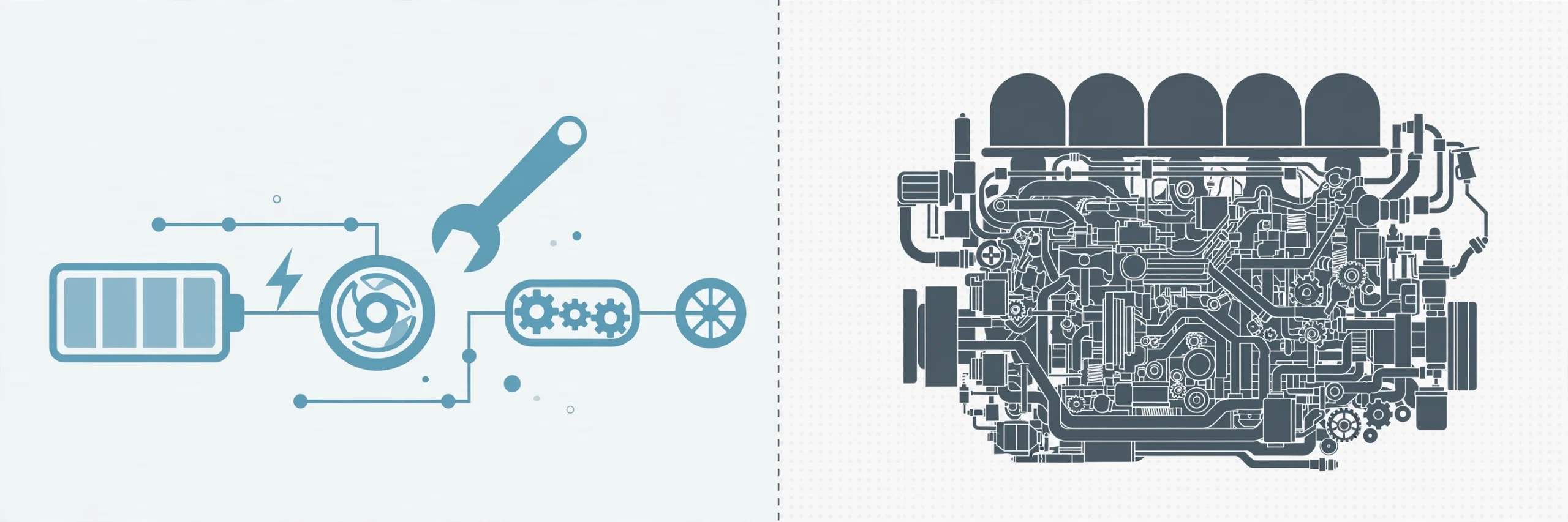
Electric cars cost roughly half as much to maintain as gas cars over their lifetime — about $0.03 per mile versus $0.06 per mile, or roughly $4,600 versus $9,200 over 200,000 miles, according to Consumer Reports member-survey data. The savings come from mechanical simplicity: no oil changes, no spark plugs, no exhaust system, no transmission service — and regenerative braking that makes brake pads last two to three times longer. For the complete financial picture beyond maintenance, see our EV vs Gas: True Cost of Ownership Compared (2026).
Why EVs need less maintenance
A battery-electric powertrain has as few as 20 moving parts, compared with more than 2,000 in a typical gas engine and transmission. Fewer parts means fewer things to wear out, break, or require scheduled service. The maintenance items that dominate gas-car ownership simply don’t exist:
- Oil changes: gone entirely — there is no engine oil to change.
- Spark plugs, air filters (engine), timing belts: no combustion, no need.
- Exhaust system: nothing to rust out or replace.
- Transmission service: most EVs use a simple single-speed reduction gear with no scheduled service.
- Emissions testing and repairs: no tailpipe, no catalytic converter to fail.
Regenerative braking adds another layer of savings. Because the motor does most of the slowing, friction brakes get used far less — brake pads and rotors on an EV commonly last two to three times longer than on a gas car.
What maintenance an EV still needs
“Less maintenance” isn’t “no maintenance.” Budget for:
- Tires: the one category where EVs cost more. EVs are heavier and deliver instant torque, so tires wear roughly 20% faster. Expect to replace tires somewhat sooner and budget a bit more per set. Regular rotation matters more, not less.
- Cabin air filter: same as any car, replaced on a similar schedule.
- Brake fluid: flushed on roughly the same interval as gas cars, even though the pads last longer.
- Coolant: EVs have thermal-management coolant for the battery and electronics, serviced at long intervals (often 100,000+ miles depending on the model).
- 12-volt battery: EVs still have a conventional 12V battery running accessories, and it still needs replacement every few years.
- Wiper blades, washer fluid, suspension wear items: same as any car.
- Software updates: many EVs update over the air; some require dealer visits for certain modules.
EV vs gas maintenance: the numbers
| Maintenance category | EV (first 100,000 miles) | Gas car (first 100,000 miles) |
|---|---|---|
| Oil changes & filters | $0 | ~$1,200 |
| Transmission service | $0 | ~$500 |
| Spark plugs / timing / exhaust | $0 | ~$1,400 |
| Brake pads & rotors | ~$200 | ~$1,100 |
| Tires (incl. rotations) | ~$2,400 | ~$2,000 |
| Cabin filter, coolant, brake fluid, 12V battery, misc. | ~$2,000 | ~$2,000 |
| Total | ~$4,600 | ~$9,200 |
| Average annual maintenance | ~$600 | ~$1,200 |
Estimates based on Consumer Reports maintenance-cost data and AAA ownership-cost reports; individual costs vary by model, driving conditions, and region.
EV service intervals: what the manual actually says
Open a typical EV owner’s manual and the scheduled-maintenance section is strikingly thin compared with a gas car. A common pattern:
- Every 7,500–10,000 miles: tire rotation, multi-point inspection.
- Every 2–3 years: cabin air filter replacement; brake fluid check/replacement per the manual’s interval.
- Every 4–5 years or ~100,000+ miles: battery/electronics coolant service (varies significantly by manufacturer — some call for it, some call it lifetime fill).
- As needed: 12V battery (every 3–5 years), wiper blades, tires.
That’s nearly the whole list. There’s no 30k/60k/90k “major service” with hundreds of dollars of engine work, because there’s no engine. The practical effect: fewer scheduled visits, shorter visits, and smaller invoices when you do go in.
The battery question: the big repair that (usually) never happens
The elephant in every EV maintenance discussion is battery replacement, with out-of-warranty bills typically estimated at $5,000–$20,000 depending on pack size. Here’s the context that matters: it is rare. Recurrent’s real-world tracking found that among EVs built from 2022 onward, only about 0.3% have needed a battery replacement, and across all EVs only around 2.5% ever have.
Federal rules require automakers to warrant high-voltage batteries for at least 8 years or 100,000 miles, and most include a capacity guarantee (typically replacement if capacity falls below ~70%). Fleet data from Geotab’s 2026 analysis of 22,700+ EVs puts average degradation at about 2.3% of capacity per year — projecting roughly 81–82% capacity remaining after eight years, comfortably above the warranty line. In practice, the battery usually outlasts the car. Our EV Battery Warranty Explained: What’s Covered & for How Long walks through what’s included in detail, and How Long Do EV Batteries Last? Real Data for 2026 has the full degradation data.
What actually voids or limits battery coverage is worth knowing: salvage/rebuilt titles, commercial or rideshare use outside the warranty terms, and unauthorized modifications. Normal degradation — the slow fade of a few percent a year — is explicitly not a warranty defect.
Insurance and repair costs: the honest caveats
Two costs can run against EVs. First, insurance: EVs often cost more to insure, partly because of higher purchase prices and partly because specialized repairs (battery enclosures, sensors, aluminum bodywork) can be expensive after a collision. Get quotes before you buy — the difference varies widely by model and insurer.
Second, out-of-warranty repairs can be steep when they do happen. EV-specific parts and the smaller independent-repair network mean a failed onboard charger or battery module can produce an eye-watering quote — one widely reported case saw a dealer quote $17,000 for a battery repair an independent EV shop did for about $8,000. The independent EV repair ecosystem is growing, and getting a second quote is as valuable as it is for gas cars.
How to keep EV maintenance costs low
- Rotate tires on schedule — it’s the highest-value maintenance item on an EV.
- Drive smoothly: gentle acceleration extends tire life, the main consumable cost.
- Use regenerative braking: one-pedal driving modes maximize both efficiency and brake life.
- Follow the coolant and brake-fluid intervals in the owner’s manual — they’re infrequent but not optional.
- Keep software updated: updates often include battery-management and efficiency improvements.
- For used EVs, check battery health before buying — a pre-purchase battery report is the EV equivalent of a compression test.
EV maintenance costs in the UK, Canada and Europe
One reason EV maintenance data translates well across borders: the maintenance list itself doesn’t change. Whether you’re driving in Texas, Manchester, Toronto or Munich, the same items apply — no oil changes, tires that wear roughly 20% faster, brake pads that last two to three times longer, and the same infrequent brake-fluid and coolant services. What differs between markets is labor rates, currency, parts availability, and the price of electricity used for charging. That means the headline finding — roughly 50% lower maintenance costs than gas cars — holds broadly in every market, even though the absolute numbers move around. Servicing costs vary by market, so treat local dealer and independent-shop quotes as the only figures that apply to you.
In the UK, the electric car maintenance cost UK question gets the same answer as anywhere else: the service schedule is the same short list, with main-dealer and independent rates set locally. Home-charging electricity averaged 26.32p/kWh under the Ofgem price cap for October–December 2026 (Direct Debit, England/Scotland/Wales average), while overnight EV tariffs run roughly 7–9p/kWh — numbers that matter for your total running costs, even though they don’t change the maintenance bill. With no oil, no exhaust and minimal brake wear, expect the maintenance savings ratio over petrol cars to look much like it does in the US; get itemized local quotes rather than relying on dollar figures converted at the exchange rate.
EV servicing in Canada follows the same pattern. The average Canadian household pays roughly 14–16¢/kWh for electricity, with big provincial differences: Quebec runs about 7–8¢, Ontario uses time-of-use pricing from 10.3–20.3¢, BC splits 9.75¢/14.08¢ across two tiers, and Alberta sits near 16.7¢. That makes the charging side of ownership cheap in most provinces, while the maintenance side — tires, cabin filters, brake fluid, coolant, the 12V battery — is the same short list as anywhere else. The one line item to watch: faster tire wear hits harder where replacement tires cost more, including winter-tire markets where a second set is effectively mandatory.
EV maintenance in Europe is no different mechanically. The EU average electricity price sits near €0.29/kWh, with Germany at roughly €0.36–0.39, France €0.22–0.27, Spain €0.21–0.27, Italy €0.30–0.32 and the Nordics a comparatively cheap €0.16–0.18 — again, charging context, not servicing. The service schedule is the same thin manual described above, and the no-oil, low-brake-wear advantages apply to European-market EVs exactly as they do elsewhere. Labor rates and parts pricing vary considerably between countries, so compare a main-dealer quote against an EV-capable independent before committing to scheduled work.
Dealer vs independent EV servicing: what owners actually pay
Main dealers have two real advantages for EV servicing: warranty work has to be done through them, and their technicians train on your specific model’s high-voltage systems and software. The trade-off is cost — dealer labor rates and OEM parts pricing run higher, and service plans sold at purchase bundle the infrequent EV services (cabin filter, brake fluid, inspections) at dealer prices. They make sense if you value one-stop convenience and plan to keep the car under warranty, less so once the warranty expires.
Independent shops are the price lever. The independent EV repair ecosystem is growing, and as the battery-repair example above showed — a $17,000 dealer quote versus about $8,000 at an independent EV shop — a second quote on any big repair is worth the phone call. Routine work like tire rotations, cabin filters and brake fluid rarely needs a dealer at all; the main exception is anything involving the high-voltage battery pack or software modules, where specialized tooling and training matter most.
OEM parts versus aftermarket is the same trade-off as with gas cars, with one EV-specific wrinkle: for high-voltage components, exact-fit OEM or equivalent-spec parts are the safe choice, while routine items — cabin filters, wiper blades, the 12V battery — are commodity parts where aftermarket is fine. Momentum around right-to-repair rules is growing in several markets, but progress is uneven, so don’t assume you can get every part and procedure manual for your model. Before booking any shop, ask whether the technicians are EV-certified, what high-voltage training they’ve completed, and how many of your model they’ve actually worked on.
One extra note on prepaid service plans: the EV service list is so short that prepaid plans often cost more than paying per visit. If a dealer offers one, ask for the plan’s itemized service list and compare it against your manual’s schedule before signing.
EV maintenance schedule: the first 150,000 miles
The owner’s manual is the final authority — intervals vary by manufacturer, and some brands bundle items into annual inspections rather than mileage milestones. But across most EVs the first 150,000 miles follow a predictable rhythm, and it’s dramatically simpler than any gas car’s schedule:
| Mileage interval | What to do |
|---|---|
| Every 7,500–10,000 miles | Tire rotation; multi-point inspection |
| Every 2–3 years | Cabin air filter replacement; brake fluid check/replacement per manual |
| Every 3–5 years | 12V battery replacement |
| ~100,000 miles (or per manual) | Battery/electronics coolant service — some manufacturers call it lifetime fill |
| As needed | Tires, wiper blades, washer fluid |
| At 150,000 miles | Full inspection; coolant and brake fluid if due; 12V battery check; tire assessment |
That’s it — no 30,000/60,000/90,000-mile major services, because there’s no engine to service. Follow the manual’s intervals rather than a generic schedule, and note that severe-use cases (towing, mountain driving, constant fast charging) can shorten some of them.
Notice what’s missing: oil changes, transmission services, spark plugs, timing belts, exhaust work. Most EV visits are inspect-and-rotate affairs that take under an hour, which is why annual maintenance bills land roughly half of a gas car’s. The 12V battery is the item that catches owners off guard — it’s the same lead-acid part gas cars use, and it fails with the same suddenness, so don’t stretch it past the manual’s interval. If you buy used, ask for service records and have the brake fluid and coolant age checked — fluids don’t care about odometer readings, and a low-mileage but older car may still be due.
Sources
- Torque News (Consumer Reports 2020 member-survey data: $0.031/mi EV vs $0.061/mi gas over 200,000 miles)
- Drive Electric Vermont (Consumer Reports findings, NYC fleet 80% maintenance reduction)
- EVGasCalc — EV Maintenance Costs vs Gas Cars (category-by-category cost breakdown)
- Squeezed — Used EV Battery Health Guide 2026 (Geotab 2.3%/yr degradation data, Recurrent replacement rates)
- Public Citizen — Affordable EVs in 2026 (AAA maintenance figures, Consumer Reports 40–50% savings)
Frequently asked questions
Do electric cars need oil changes?
No. Battery-electric vehicles have no engine oil. This alone saves roughly $150–$300 per year compared with a gas car.
How often do EV brakes need replacing?
Much less often than gas cars — regenerative braking handles most deceleration, so pads and rotors commonly last two to three times longer. Many EV owners go 100,000+ miles on original brakes.
Are EV tires more expensive?
Often slightly, yes — and they wear about 20% faster due to vehicle weight and instant torque. Tires are the one routine cost where EVs lose to gas cars, so rotation schedules matter.
What happens if my EV battery dies out of warranty?
Full pack replacement typically runs $5,000–$20,000, but it’s rare (about 2.5% of EVs ever, 0.3% for 2022+ models). Module-level repairs by independent EV shops are often far cheaper than dealer full-pack quotes.
Do EVs need less maintenance than hybrids?
Yes — a pure EV skips everything a hybrid still needs for its gas engine (oil, spark plugs, exhaust). Plug-in hybrids sit in between: less engine wear than a conventional car, but more maintenance than a pure EV.
Is EV maintenance really half the cost?
Consumer Reports’ data puts lifetime maintenance and repair at about 50% less per mile for EVs versus gas cars — roughly $4,600 vs $9,200 over 200,000 miles. Your results vary with model, driving, and tire habits; see our full EV ownership cost comparison for the complete picture.
How much does EV maintenance cost in the UK?
The same short maintenance list applies — no oil, longer-lasting brakes, faster tire wear — so expect the same roughly-50% savings ratio against petrol cars, with servicing costs set by local dealer and independent rates. UK home charging averaged 26.32p/kWh under the October–December 2026 Ofgem cap (roughly 7–9p/kWh on overnight EV tariffs), which shapes overall running costs but not the maintenance bill itself.
Are electric cars cheaper to maintain in Canada?
Yes — the maintenance items are identical to anywhere else, so the same roughly half-cost advantage over gas cars applies. Canada’s relatively cheap electricity (about 14–16¢/kWh on average, as low as roughly 7–8¢ in Quebec) strengthens the overall ownership case. The main Canadian wrinkle is tires: faster EV tire wear plus winter-tire use in cold provinces makes rotation schedules and seasonal swaps worth planning for.
Do EVs need regular servicing in Europe?
Yes, but the schedule is thin: tire rotations every 7,500–10,000 miles, cabin filter every 2–3 years, brake fluid and coolant per the manual, and a 12V battery every 3–5 years. Intervals vary by manufacturer, so follow the owner’s manual rather than a generic schedule. Charging costs vary widely — the EU averages about €0.29/kWh, from roughly €0.16–0.18 in the Nordics to €0.36–0.39 in Germany — but that affects running costs, not maintenance.
The bottom line: EV maintenance is simpler, cheaper, and less frequent than gas-car maintenance — roughly half the lifetime cost. The savings are real and well-documented; the caveats (tires, insurance, rare big repairs) are manageable with eyes open.

Content Writer | Automotive News & Electric Vehicles
Rihanna Khan writes for The Roadster, covering electric vehicles, EV charging, battery technology, car ownership, and the latest automotive developments. Her articles aim to make technical topics and buying decisions easier to understand.
Focus Areas: Electric Vehicles · Automotive News · EV Charging · Car Ownership


